Reference: https://www.youtube.com/watch?v=QkdkLdMBuL0&t=56s
Direct communication between different services in a micro services architecture can become complex and result in high Coupling.
Post Office Analogy
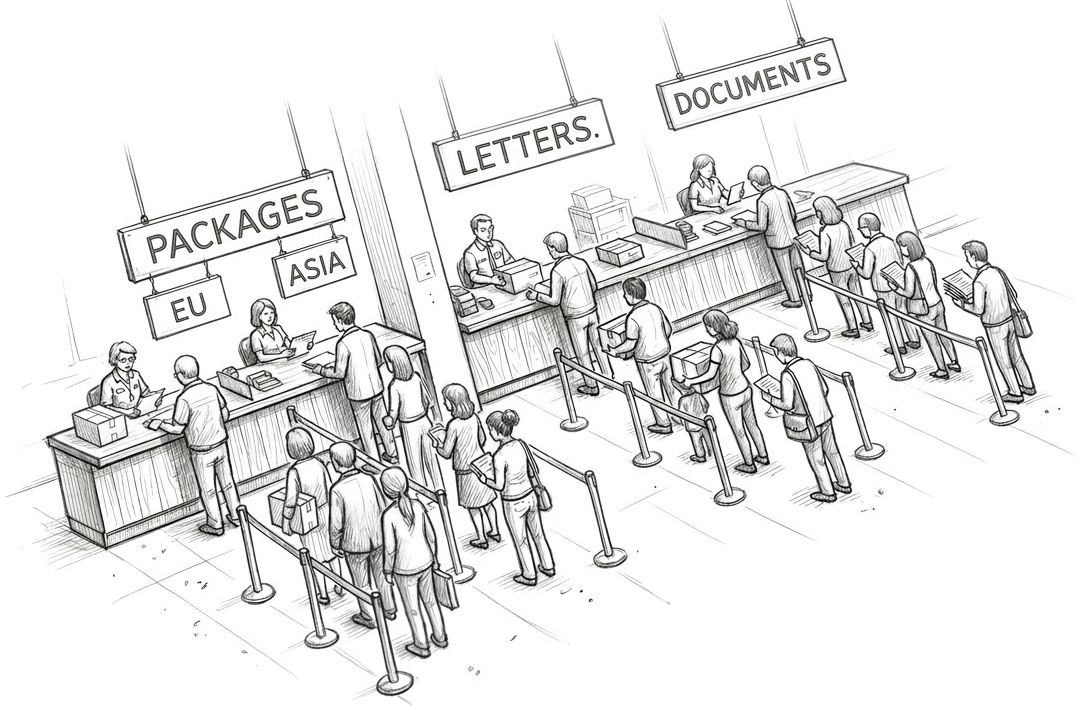
Let’s consider the scenario of people sending letters to each other. Rather than writing letters and having to physically deliver them to the recipient (time consuming), you can just leave them at the post office and let them handle the communication. In this way, you can dedicate all your time to writing.
Some people want to send letters, others packages, documents, etc. The post office usually has different queues to process each type of incoming delivery. Furthermore, for highly busy queues (e.g. packages), the post office can add more workers that handle packages targeted to Europe, others to Asia, and so on.
Kafka Overview
Apache Kafka is like a post office but for communications between different services in your system.
In our analogy, these would be the Kafka equivalents:
- Post Office - Broker
- Queue - Topic
- Letter - Event
- EU vs US - Partition
Services (producers) can produce events (e.g. letter) and publish them to topics (e.g. letters queue). Other services (consumers) who are interested in receiving events of some type subscribe to topics. If a topic has many traffic, we can create logical partitions (e.g. EU letters, US letters), so that many producers can publish to the same topic at the same time and more workers can process the events.
Brokers
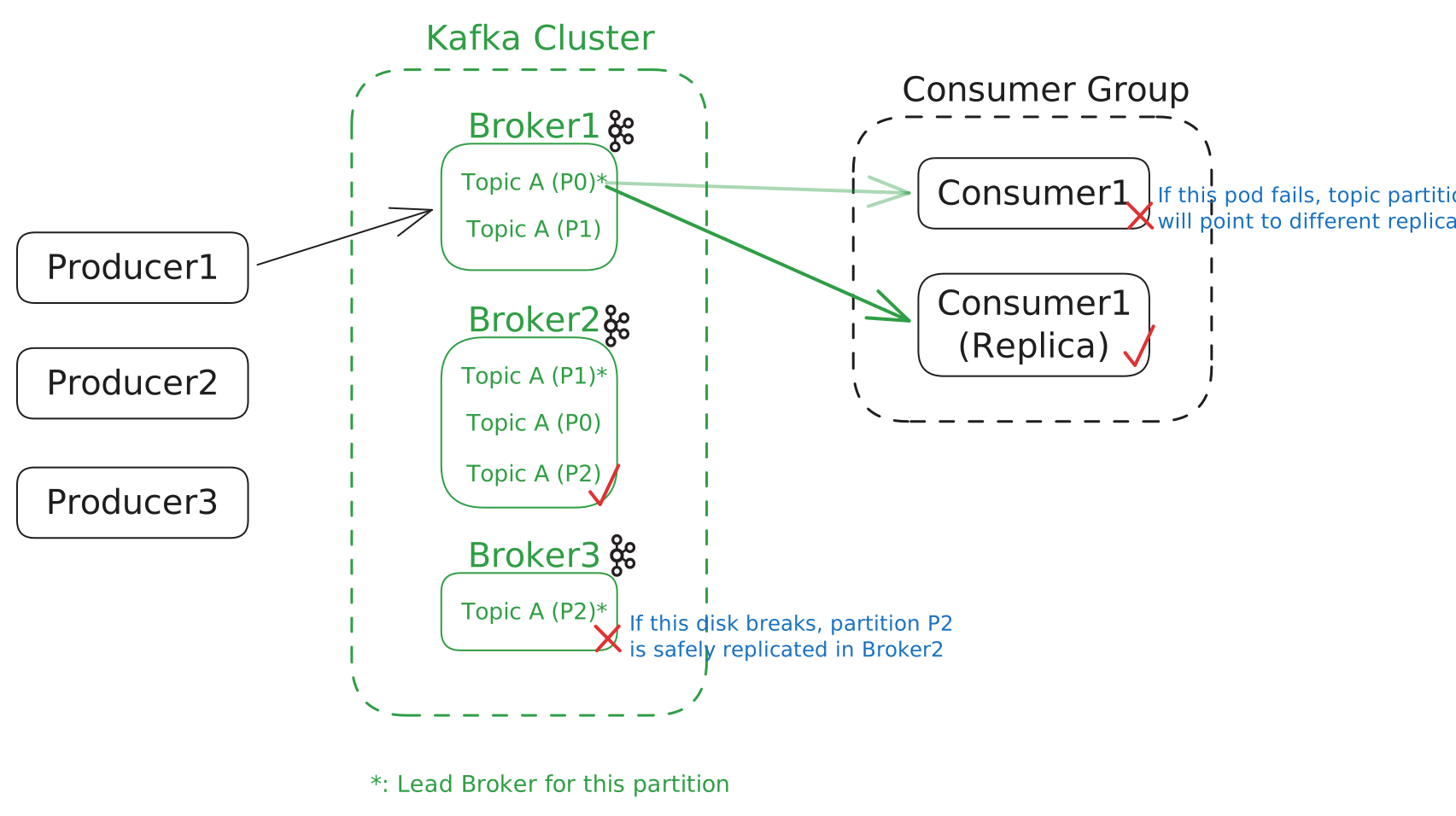
A broker is a server. Having many is like having many post office locations (scale and fault tolerance). Brokers persist in disk the events they process (reproducibility, on demand consumption), and handle message distribution to consumers.
Partitions
A topic partition can be distributed in many brokers. Thus, each partition has a leader broker and multiple replicas
Consumer Groups
A service pod will identify itself with a group ID (e.g. “billing-team”). When you scale a service and many equivalent pods are created (creating a consumer group), Kafka knows which type are they because of the group ID. Kafka will automatically distribute topic partitions to point to different replicas in the same consumer group (load balancing). If a pod fails, Kafka redirects the topic partition to point to a different pod that is alive.
Extend Note:
- Kafka Streaming
- Raft Consensus
- Code