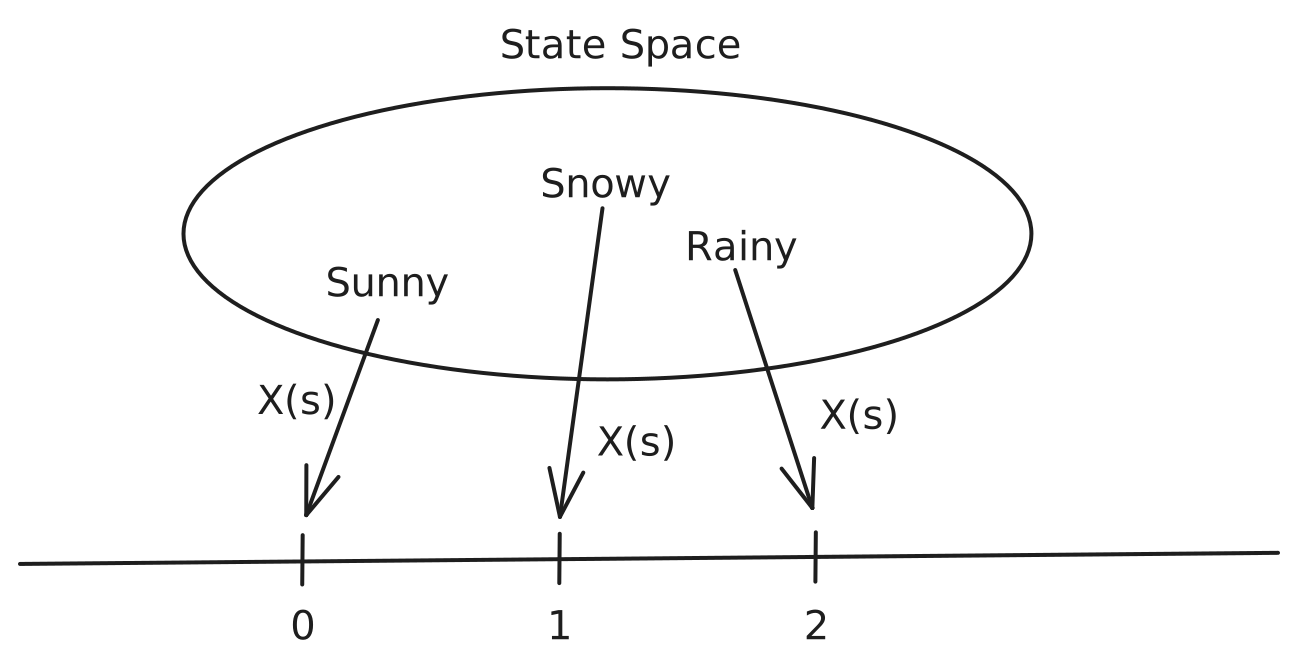
It is a function that maps elements from a state space to . Random variables are written with upper case letters such as X, Y or Z. It is possible to map two elements from the state space to the same output.
The output of a random variable can be in a finite or infinite range. In both cases, we have two types:
Discrete
We could count the output elements of the random variable. That is, there are no values in between one element and the next (e.g. ).
Continuos
The output elements could take any (infinite) values within a range (e.g. ).
Why use random variables?
-
Quantification: They map qualitative outcomes (e.g. “Sunny”) to real numbers ().
-
Simplification: They allow us to ignore irrelevant details. If you only care about the sum of two rolled dice, a random variable treats and as the same value (), even though they are different states.
-
Functional Power: Once outcomes are numbers, we can use better use mathematical tools to describe the system behavior.
Overall, I think one of the strongest reasons why random variables are so useful is because of their abstraction power. We can say “this process follows a Normal Distribution” without needing to know if the underlying states are heights of people, errors in a clock, or light particles. It provides a universal language for different phenomena.